What We're Taking Forward From NASP inSPire 2026
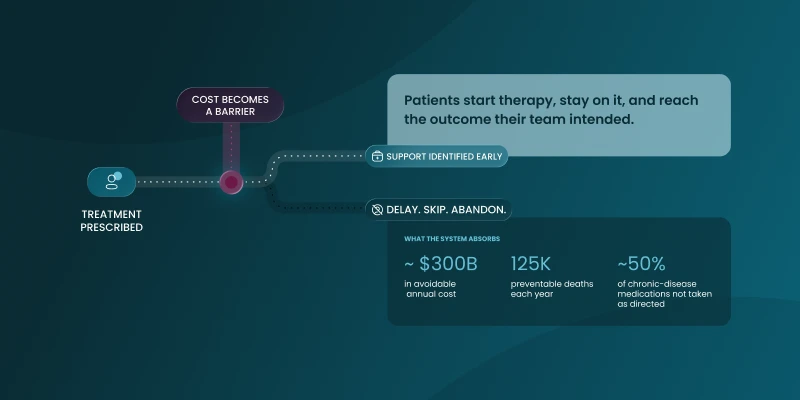
At NASP inSPire 2026, the same idea kept resurfacing in every session and conversation: the next phase of specialty pharmacy depends on how well the industry removes the barriers standing between patients and therapy.
Technology, patient access, operational efficiency, the growing complexity of specialty medications: every thread led back to the patient journey.
For TailorMed, that conversation is central to the work we do every day. We came to National Harbor ready to talk about how technology helps specialty pharmacies scale patient support. We left more convinced that scale alone is not the goal. The real opportunity is making the medication journey work better for every patient who moves through it.
Here are a few ideas we're taking forward.
AI is moving from possibility to practicality
Artificial intelligence was impossible to ignore at inSPire 2026, but the conversation has moved past whether AI belongs in specialty pharmacy. The more useful questions now are where it delivers real value, how it fits into existing workflows, and where human expertise still has to lead.
That was the focus of our panel, "Automating the Patient Journey: How Specialty Pharmacies Are Using Artificial Intelligence to Scale," moderated by TailorMed CEO Srulik Dvorsky.
For specialty pharmacies, the opportunity is significant. Teams manage complex workflows across benefits investigations, prior authorization, financial assistance, patient outreach, enrollment, refill coordination and adherence, and much of that work is still manual. AI and automation can take on more of that administrative burden.
At TailorMed, we already use automation and AI to help identify patients who may need financial assistance, determine eligibility, organize workflows and simplify enrollment across the medication journey. The goal isn't to remove people from patient support; it's to give them more capacity to provide it. When technology handles the repetitive work and surfaces the right action at the right moment, pharmacists and care teams can spend more time on the decisions and conversations where their expertise actually matters.
Scaling patient support cannot mean adding more work
Capacity was the theme underneath many of our conversations. Specialty pharmacy keeps growing more complex: advanced therapies are expanding, patient needs are evolving, and access and reimbursement requirements remain difficult. At the same time, pharmacy teams are being asked to support more patients without endlessly adding staff.
The traditional answer has often been another portal, another point solution, or another workflow for the pharmacy team to manage. That approach has limits.
Scaling successfully requires technology that works within the medication journey and removes steps instead of creating them. Automation should reduce manual searches, duplicate data entry and follow-up. Patient-facing technology should let people complete the steps they can handle themselves. Connected data should make it easy for teams to see where a patient is in the journey and what needs to happen next. Every unnecessary administrative step consumes capacity that could go toward supporting patients instead.
The patient journey still has too many handoffs
Specialty pharmacy doesn't operate in isolation. A single medication journey can move among prescribers, health systems, specialty pharmacies, manufacturers, patient support programs, foundations and patients themselves, and every transition is another chance for information to get lost or action to stall.
That fragmentation matters even more as the industry automates more of the journey. Automating one task inside one organization creates efficiency. Connecting those tasks across organizations creates something more valuable: continuity. This is where we believe the industry's technology conversation needs to go next.
TailorMed's network now reaches more than 75 million patients across more than 950 hospitals, 4,700 clinics and 3,100 pharmacies. That connectivity lets support extend across the places where medications are prescribed and dispensed, instead of starting over every time a patient moves from one stakeholder to another. The future of medication access will require more of that connection.
Better technology should create a better patient experience
Efficiency matters, and so do operational and financial results. But the reason to improve specialty pharmacy workflows is to improve what patients actually experience.
Patients shouldn't need to understand the infrastructure behind their medication journey. They shouldn't have to know which organization owns which step, search for assistance on their own, or repeatedly hand over the same information because systems can't talk to each other. They should experience a clear path to therapy: barriers identified earlier, enrollment made easier, patients connected to the support programs they're eligible for, kept informed about what happens next, and engaged well beyond the first fill so that access becomes medication success.
Technology can make each of those things easier, but only when it's designed around the journey rather than a single transaction.
Where we go from here
We came to inSPire 2026 excited to talk about AI. We're leaving even more focused on what AI and automation should help the specialty pharmacy community accomplish: more patients identified before they fall through the cracks, support activated the moment it's needed, less administrative work for pharmacy teams, and more patients able to start and stay on the therapies their providers prescribed.
The specialty pharmacy industry doesn't need technology because it's new. It needs technology that makes an increasingly complex system easier to navigate, for the people working in it and, most importantly, for the patients depending on it.
Thank you to everyone who joined us at booth 124, attended our panel, and shared what your teams are seeing every day. Those conversations are what make inSPire valuable, and they're the ones we'll keep having long after the exhibit hall closes.
Ready to continue the conversation?
TailorMed is the medication success platform connecting patients, providers, pharmacies and life sciences organizations to remove barriers across the medication journey and make medication success possible.
About TailorMed
TailorMed is the medication success platform removing every barrier across the patient medication journey, from access and affordability through adherence and ongoing care. Through a connected network spanning 945+ hospitals, 4,700+ clinics, 3,100+ pharmacies, 100+ life sciences programs, and 6,000+ support programs, TailorMed has supported over 75 million patients and secured more than $7.4 billion in financial assistance since 2020. TailorMed's platform, including TailorMed Core, TailorMed Connect, TailorMed Complete, TailorMed Amplify, and TailorMed Alliance, connects patients, providers, pharmacies, and life sciences companies through one coordinated network designed to reach every patient at every step of their medication journey. Learn more at tailormed.com.
Media Contacts:
Jennifer Martin, VP, Marketing
jenm@tailormed.co
PR Contacts:
Glenn Goldberg
Parallel Communications Group
+1 516 776-3282
𝕏: @Parallel_PR
LinkedIn
ggoldberg@parallelpr.com
.webp)