The Real Costs of Nonadherence
Why Affordability Is a Healthcare Problem, Not Just a Patient Problem
Healthcare organizations have long focused on the financial consequences of uncompensated care. But today, leading health systems are recognizing a more urgent issue upstream: patient nonadherence.
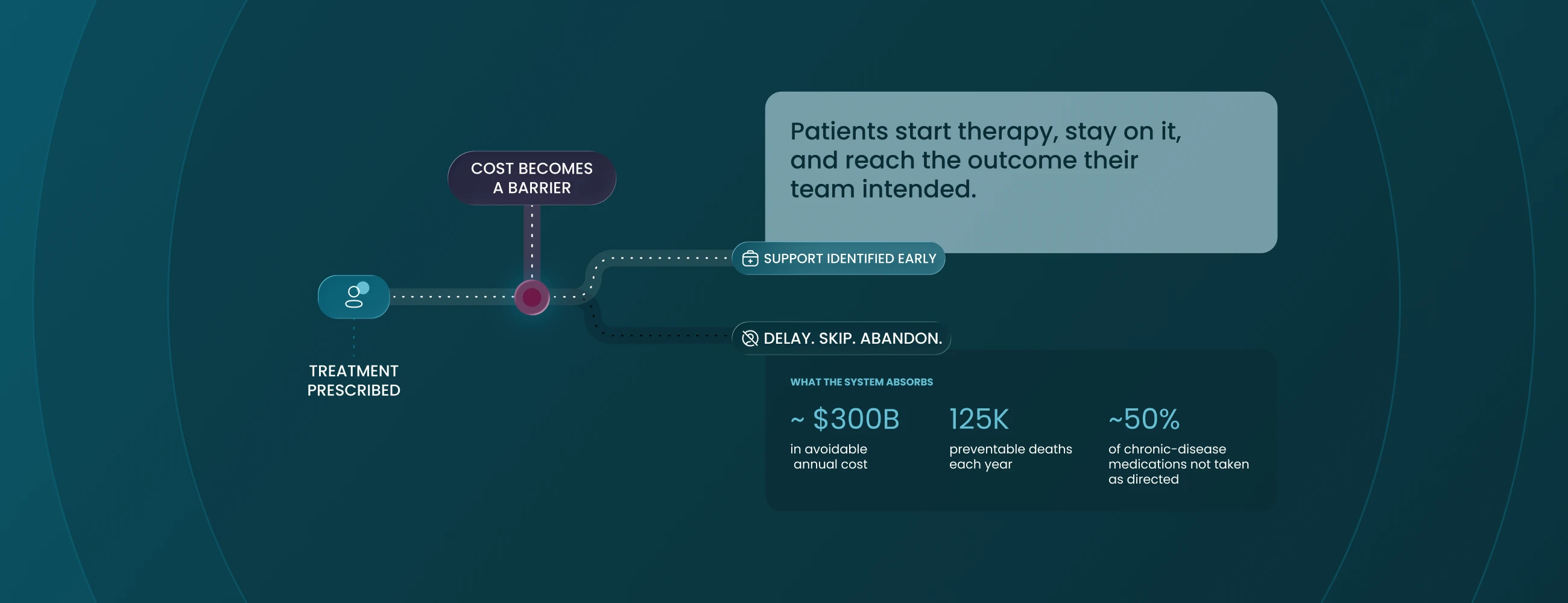
When patients delay treatment, skip medications, or abandon therapy because of cost, the consequences extend far beyond an unpaid bill. Nonadherence drives poorer outcomes, avoidable utilization, lost revenue, and higher total costs across the healthcare ecosystem.
For providers facing increasing pressure to improve outcomes while managing margins, addressing affordability is no longer simply a patient support initiative. It has become a strategic imperative.
The Growing Cost of Nonadherence
Medication and treatment nonadherence remain among the most expensive and persistent challenges in healthcare. Researchers estimate that medication nonadherence costs the U.S. healthcare system between $100 billion and $300 billion annually through avoidable hospitalizations, emergency department visits, and preventable complications.[1] The impact extends across nearly every disease state and care setting.
The human toll is equally significant. Poor medication adherence is associated with approximately 125,000 preventable deaths each year in the U.S. and contributes to millions of unnecessary medical visits and hospitalizations.[2]
Despite advances in treatment, adherence remains a major challenge. The CDC reports that approximately 50% of medications prescribed for chronic diseases are not taken as directed.[3]
For healthcare organizations, these statistics represent more than a clinical concern. They reveal a significant operational and financial risk.
Affordability Remains a Leading Driver
Patients rarely choose nonadherence because they do not value their care. More often, they face difficult financial decisions. High deductibles, coinsurance requirements, specialty drug costs, transportation expenses, and lost income can quickly create barriers to treatment. Even insured patients frequently struggle with affordability.
The problem is especially acute in oncology. According to the American Cancer Society, the burden of cancer on patients and health systems continues to grow: an estimated 2,114,850 Americans will be diagnosed with cancer in 2026, and more than 626,140 will die from the disease.[4] As new therapies continue to improve outcomes, ensuring patients can afford and adhere to treatment becomes even more critical.
The Hidden Impact on Health Systems
When affordability challenges go unidentified, the effects ripple throughout the organization.
Patients who cannot afford treatment are more likely to delay care, miss appointments, abandon therapy, or experience disease progression. These disruptions often lead to higher-cost interventions later, including emergency care, hospital admissions, and avoidable complications.[1]
For providers, the result is a cycle of increasing utilization, worsening outcomes, and growing financial pressure.
In value-based care arrangements, nonadherence can directly affect quality metrics, patient outcomes, and reimbursement. In fee-for-service environments, it contributes to treatment disruption, missed revenue opportunities, and higher levels of uncompensated care.
Either way, healthcare organizations bear the consequences.

Why Traditional Financial Assistance Approaches Fall Short
Historically, financial assistance programs have relied on manual referrals, fragmented workflows, and reactive outreach. The challenge is not a lack of resources. Today, thousands of manufacturer assistance programs, charitable foundations, copay support programs, and government resources exist to help patients manage the cost of care. The challenge is identifying eligible patients early enough and connecting them to the right support before affordability becomes a barrier.
Many organizations still rely on patients to self-identify financial distress or wait until missed payments reveal a problem. By that point, the patient may have already delayed treatment, skipped doses, or abandoned therapy altogether.
Moving From Financial Assistance to Financial Navigation
Forward-thinking health systems are taking a more proactive approach. Rather than waiting for financial hardship to surface, they are embedding support into the medication journey itself and reframing the goal. The aim is not just financial assistance but full medication success: patients who start therapy, stay on it, and achieve the outcomes their care team intended.
Modern approaches use data, automation, and real-time insights to identify at-risk patients earlier, uncover available assistance opportunities, and streamline enrollment into support programs. This is the problem TailorMed was built to solve.
TailorMed is a network-powered platform for removing barriers across the medication journey. Care teams use TailorMed Core to manage the full lifecycle of patient support programs. The TailorMed Network reaches more than 75.1 million patients across 4,700+ clinics, 945+ hospitals, and 3,100+ pharmacies nationwide, and that scale is what makes proactive identification possible.
By addressing financial barriers before they affect treatment decisions, organizations can improve adherence, reduce administrative burden, and help patients stay on therapy. The goal is no longer simply reducing bad debt. It is ensuring patients can access, afford, and adhere to the care they need.
Turning Affordability Into Better Outcomes
Healthcare organizations cannot solve every challenge affecting adherence. But affordability remains one of the most actionable barriers.
When patients receive support before costs become overwhelming, they are more likely to initiate treatment, remain on therapy, and achieve better outcomes. Providers benefit through stronger performance, improved operational efficiency, and more sustainable financial results.
The future of patient support is proactive, network-powered navigation that identifies risk early, removes barriers to care, and helps patients stay on the treatment path their clinicians intended. Because the real cost of nonadherence is measured not only in dollars, but in missed opportunities to improve lives.
References
- Iuga AO, McGuire MJ. Adherence and Health Care Costs. Risk Management and Healthcare Policy. 2014.
- American Heart Association. Medication Adherence: Taking Your Meds as Directed. January 2024.
- Neiman AB, et al. CDC Grand Rounds: Improving Medication Adherence for Chronic Disease Management — Innovations and Opportunities. Morbidity and Mortality Weekly Report. 2017.
- American Cancer Society. Cancer Facts & Figures 2026.
About TailorMed
TailorMed is the medication success platform removing every barrier across the patient medication journey, from access and affordability through adherence and ongoing care. Through a connected network spanning 945+ hospitals, 4,700+ clinics, 3,100+ pharmacies, 100+ life sciences programs, and 6,000+ support programs, TailorMed has supported over 75 million patients and secured more than $7.4 billion in financial assistance since 2020. TailorMed's platform, including TailorMed Core, TailorMed Connect, TailorMed Complete, TailorMed Amplify, and TailorMed Alliance, connects patients, providers, pharmacies, and life sciences companies through one coordinated network designed to reach every patient at every step of their medication journey. Learn more at tailormed.com.
Media Contacts:
Jennifer Martin, VP, Marketing
jenm@tailormed.co
PR Contacts:
Glenn Goldberg
Parallel Communications Group
+1 516 776-3282
𝕏: @Parallel_PR
LinkedIn
ggoldberg@parallelpr.com
View More News & Blogs
.webp)
Healthcare Affordability Requires a Connected Consumer Experience
.webp) Leading with the Patient in Mind: A Conversation with Kimberly Pellish, Vice President of Customers
Leading with the Patient in Mind: A Conversation with Kimberly Pellish, Vice President of Customers