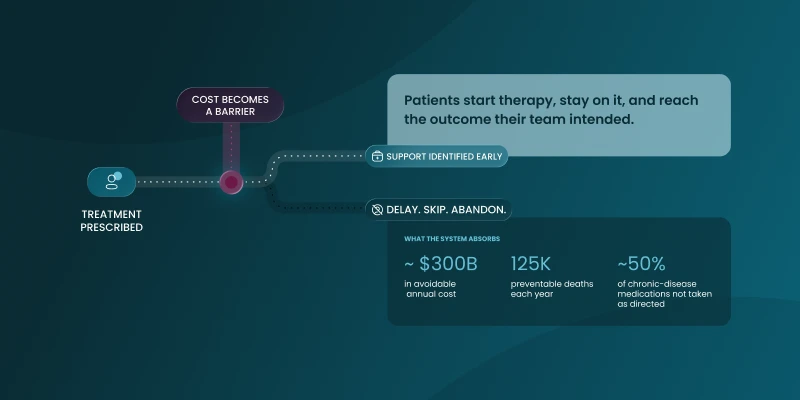
Patient Success Moments vs. Patient Success Outcomes

Why Measuring What Happens Next Matters
A patient receives financial assistance and fills their prescription.
A patient secures transportation to a critical oncology appointment.
A patient avoids treatment abandonment after discovering they qualify for support.
These moments matter. They represent real barriers removed, real stress relieved, and real patients gaining access to care they might otherwise forgo. But as healthcare organizations face growing pressure to improve outcomes, reduce costs, and demonstrate the value of patient support programs, one question remains: What happens next?
The difference between a patient success moment and a patient success outcome is the difference between solving an immediate problem and creating a measurable improvement in a patient's medication journey.
As health systems, specialty pharmacies, and provider organizations invest more heavily in financial navigation and affordability programs, measuring long-term outcomes has become just as important as measuring the interventions themselves.
When Success Is Measured by Activity Alone
Many patient support programs are evaluated based on operational metrics: patients screened, financial assistance applications submitted, dollars secured, prior authorizations completed, referrals made, and patients contacted.
These metrics provide valuable insight into program activity and efficiency. They help organizations understand whether workflows are functioning as intended.
But they do not answer the most important question: Did the intervention ultimately improve the patient's ability to access and remain on treatment?
A patient may receive financial assistance today and discontinue therapy three months later. A patient may enroll in a support program and still face recurring affordability challenges that lead to missed doses or delayed care. Without visibility into what happens after an intervention, organizations risk celebrating isolated wins while missing opportunities to improve long-term outcomes.
Moments measure effort. Outcomes measure impact.
Why Long-Term Outcomes Matter More Than Ever
The financial barriers facing patients continue to grow in both scale and complexity.
According to IQVIA's The Use of Medicines in the U.S. 2024 report, patients starting new therapies abandoned approximately 98 million prescriptions at the pharmacy in 2023, underscoring the persistent impact of affordability challenges on treatment access and adherence.[1]
Financial barriers are particularly problematic for patients prescribed specialty therapies. A systematic review published in the Journal of Managed Care and Specialty Pharmacy found that higher out-of-pocket costs are consistently associated with increased prescription abandonment and lower adherence rates across specialty medication categories.[2]
Healthcare leaders increasingly recognize that financial hardship is not simply an economic issue. It is a clinical one. The National Cancer Institute notes that financial toxicity can affect treatment decisions, quality of life, treatment adherence, and overall health outcomes.[3]
For healthcare organizations, that means the goal cannot simply be helping a patient overcome a barrier once. The goal must be helping patients remain engaged in care, stay on therapy, and achieve better outcomes over time.
Measuring What Matters
To understand whether patient support programs are truly working, organizations need visibility beyond individual interventions. Leading organizations are focusing on outcome-oriented metrics across five key areas, the same metrics that TailorMed Core is built to track across the full program lifecycle.
Therapy Initiation. Did the patient actually start treatment after support was provided? Tracking approvals without measuring therapy starts leaves important gaps in understanding where patients continue to face barriers.
Treatment Adherence and Persistence. Did the patient remain on therapy? Longitudinal adherence and persistence data help organizations understand whether affordability interventions are creating lasting impact.
Time-to-Treatment. How quickly did patients begin therapy after receiving support? Reducing delays improves both patient experience and operational performance.
Financial Stability. Did the patient's financial burden improve over time? Tracking recurring assistance needs and financial distress indicators helps organizations identify patients who may need ongoing support.
Longitudinal Engagement. Did patients require additional interventions later in their treatment journey? Understanding recurring barriers reveals opportunities for earlier intervention and more proactive patient support.
From Financial Assistance to Longitudinal Impact
At TailorMed, we believe affordability is more than a financial challenge. It is a critical driver of patient access, treatment adherence, and overall care outcomes. Every abandoned prescription, delayed treatment, or interrupted therapy represents more than a missed opportunity for assistance. It represents a patient whose care journey may be at risk.
That is why TailorMed is the Medication Success Platform, built on a network that removes barriers across the medication journey, not just at the moment a financial assistance program is approved. Leading healthcare organizations are moving beyond transactional measures of success and focusing on longitudinal impact. By bringing together affordability intelligence, financial assistance workflows, patient engagement, and analytics across the TailorMed Network, organizations gain greater visibility into how financial interventions influence the broader patient journey.
This connected approach helps organizations:
- Identify patients at risk of treatment abandonment
- Streamline access to financial assistance programs
- Reduce delays in care
- Improve therapy initiation and persistence
- Measure the long-term impact of support programs
- Demonstrate value to organizational leadership
Most importantly, it helps ensure that patients receive the support they need throughout their treatment journey.
Measuring What Matters Most
Patient success moments will always matter. A financial assistance approval, a transportation solution, or a successful enrollment can represent a life-changing breakthrough for a patient facing barriers to care. But healthcare organizations need more than moments. They need visibility into what happens next.
The future of patient support lies in connecting interventions to outcomes: understanding how affordability programs influence treatment initiation, adherence, persistence, and long-term medication success. Organizations that make that connection will be better positioned to improve patient outcomes, demonstrate program value, and maximize the impact of every support dollar invested.
The goal is not simply helping patients overcome today's barrier. It is helping them stay on the path to better health tomorrow.
References
- IQVIA Institute. The Use of Medicines in the U.S. 2024: Usage and Spending Trends and Outlook to 2028. May 2024.
- Ismail WW, Witry MJ, Urmie JM. The association between cost sharing, prior authorization, and specialty drug utilization: A systematic review. Journal of Managed Care and Specialty Pharmacy. 2023;29(5):449-463.
- National Cancer Institute. Financial Toxicity (Financial Distress) and Cancer Treatment (PDQ). Updated May 29, 2024.
About TailorMed
TailorMed is the medication success platform removing every barrier across the patient medication journey, from access and affordability through adherence and ongoing care. Through a connected network spanning 945+ hospitals, 4,700+ clinics, 3,100+ pharmacies, 100+ life sciences programs, and 6,000+ support programs, TailorMed has supported over 75 million patients and secured more than $7.4 billion in financial assistance since 2020. TailorMed's platform, including TailorMed Core, TailorMed Connect, TailorMed Complete, TailorMed Amplify, and TailorMed Alliance, connects patients, providers, pharmacies, and life sciences companies through one coordinated network designed to reach every patient at every step of their medication journey. Learn more at tailormed.com.
Media Contacts:
Jennifer Martin, VP, Marketing
jenm@tailormed.co
PR Contacts:
Glenn Goldberg
Parallel Communications Group
+1 516 776-3282
𝕏: @Parallel_PR
LinkedIn
ggoldberg@parallelpr.com
.webp)