


The Handoff Failure
Where Patients Fall Out of the Medication Journey
Healthcare organizations have invested heavily in expanding access to financial assistance. Copay programs, manufacturer support, foundation grants, free drug programs, and internal financial assistance funds have created more opportunities than ever to help patients afford treatment.
Yet one of the greatest barriers to affordability is not a lack of available assistance. It is the handoff.
Every patient journey includes a series of transitions: from diagnosis to treatment planning, from provider to specialty pharmacy, from financial navigator to patient, from enrollment to activation. At each transition point, information can be lost, actions can stall, and patients can disappear. The result is a problem hiding in plain sight: patients who qualify for assistance never receive it.
The Hidden Cost of Lost Momentum
Financial toxicity remains one of healthcare's most persistent barriers to treatment access.
According to the National Cancer Institute, patients with cancer are significantly more likely than individuals without cancer to experience financial hardship and distress related to the cost of care.[1]
Recent research continues to demonstrate the scale of the challenge. A 2025 systematic review found that up to 48% of cancer survivors experience measurable financial toxicity, while as many as 73% report subjective financial burden associated with their care.[2]
The financial impact begins almost immediately after diagnosis. A 2025 study published in JAMA Network Open found that privately insured patients experienced an average increase of $592 per month in out-of-pocket costs during the first six months following a cancer diagnosis. For patients with Stage IV disease, monthly costs increased by nearly $720.[3]
When affordability concerns intersect with complex enrollment processes, treatment delays become more likely and patient outcomes can suffer.[4] The challenge is ensuring patients successfully navigate the path to receiving available support.
Where Patients Disappear
Most organizations can identify affordability resources. Fewer can consistently identify where patients are lost along the journey.
Patients commonly drop out at these critical points:
- A referral is submitted but not acted upon
- An enrollment application is started but never completed
- Additional documentation creates delays
- A patient receives instructions but never returns to finish enrollment
- A pharmacy waits for affordability confirmation before dispensing medication
- Care teams lack visibility into application status
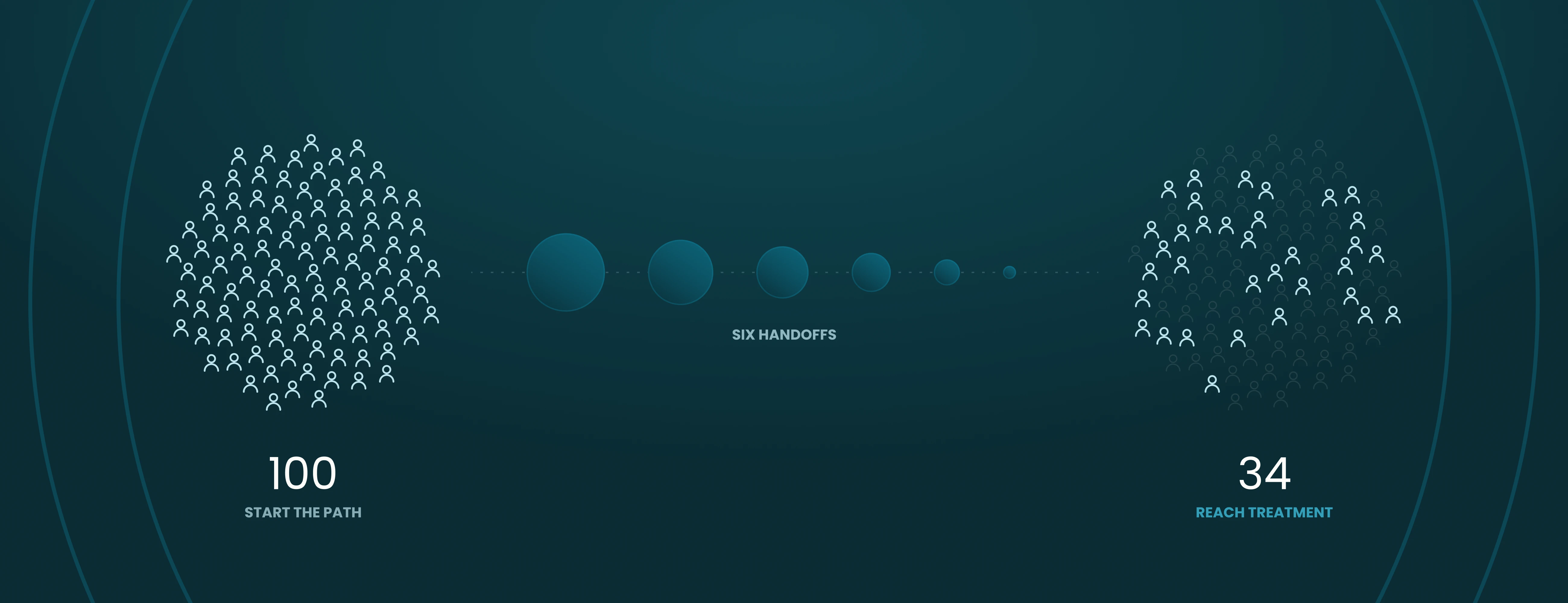
None of these events appear catastrophic in isolation. Together, they create significant patient loss across the affordability ecosystem. Consider a simplified illustration of how this plays out: of 100 patients identified with financial need, 87 complete referral, 72 begin enrollment, 58 submit documentation, 46 receive approval, 39 activate assistance, and only 34 start treatment. Every handoff creates additional friction and another opportunity for abandonment.
Why Traditional Workflows Break Down
Historically, affordability workflows have relied on manual coordination between providers, pharmacies, manufacturers, support programs, and patients. Teams juggle multiple portals, spreadsheets, emails, faxes, and phone calls. Patients receive fragmented communications and are frequently asked to repeat information across multiple touchpoints. As healthcare grows more complex, these disconnected workflows become increasingly difficult to scale. Healthcare organizations cannot afford to lose patients because administrative processes create unnecessary barriers to access.
Closing the Gaps Between Handoffs
Reducing patient abandonment requires more than identifying additional funding sources. Organizations must actively remove friction from every transition point.
That means:
- Identifying at-risk patients earlier
- Automating resource matching
- Streamlining enrollment workflows
- Reducing documentation burdens
- Delivering timely, personalized patient engagement
- Providing visibility across the medication journey
- Monitoring patient progress from identification through therapy initiation
Technology plays a critical role because it shifts affordability support from a reactive process into a proactive one. Rather than waiting for patients to report financial distress, organizations can identify barriers earlier and intervene before treatment delays occur.
At TailorMed, care teams use TailorMed Core to manage the full lifecycle of patient support programs, with visibility into every transition and progress monitoring from identification through therapy initiation. That visibility runs on TailorMed's network, connecting patients, providers, pharmacies, life sciences companies, and financial assistance programs to reduce patient drop-off and improve access.
From Handoffs to Continuity
The future of patient affordability is about creating continuity across the entire patient journey.
Organizations that successfully reduce patient abandonment recognize that every handoff matters. Each transition is a moment when patients can either move closer to treatment or slip through the gaps. The most effective affordability strategies both identify available assistance and ensure patients successfully reach it. Because when a patient abandons treatment due to cost, or because the enrollment process becomes too difficult, the affordability problem has not been solved.
When healthcare organizations make the invisible gaps visible, they can begin closing them and ensure more patients get the care they need without financial barriers standing in the way.
References
- National Cancer Institute. Financial Toxicity (Financial Distress) and Cancer Treatment (PDQ). Updated May 29, 2024.
- Kadambi S, Wang Y, Job A, et al. Financial Toxicity in Older Adults With Cancer and Their Caregivers. JCO Oncology Practice. 2025;21(1):92-99.
- Rose L, Rajasekar G, Nambiar A, et al. Estimated Out-of-Pocket Costs for Patients With Common Cancers and Private Insurance. JAMA Network Open. 2025;8(7):e2521575.
- Budhu JA, Tin AL, Steele M, et al. Screened but Still Struggling: Challenges in Delivering Financial Assistance After Positive Financial Toxicity Screens. JCO Oncology Practice. 2025;21(12):1868-1875.
About TailorMed
TailorMed is the medication success platform removing every barrier across the patient medication journey, from access and affordability through adherence and ongoing care. Through a connected network spanning 945+ hospitals, 4,700+ clinics, 3,100+ pharmacies, 100+ life sciences programs, and 6,000+ support programs, TailorMed has supported over 75 million patients and secured more than $7.4 billion in financial assistance since 2020. TailorMed's platform, including TailorMed Core, TailorMed Connect, TailorMed Complete, TailorMed Amplify, and TailorMed Alliance, connects patients, providers, pharmacies, and life sciences companies through one coordinated network designed to reach every patient at every step of their medication journey. Learn more at tailormed.com.
Media Contacts:
Jennifer Martin, VP, Marketing
jenm@tailormed.co
PR Contacts:
Glenn Goldberg
Parallel Communications Group
+1 516 776-3282
𝕏: @Parallel_PR
LinkedIn
ggoldberg@parallelpr.com
View More News & Blogs
The Real Costs of Nonadherence
.webp)
Healthcare Affordability Requires a Connected Consumer Experience
.webp) Leading with the Patient in Mind: A Conversation with Kimberly Pellish, Vice President of Customers
Leading with the Patient in Mind: A Conversation with Kimberly Pellish, Vice President of Customers