Why Up to 40% of New Specialty Prescriptions Never Reach Patients
A prescription should be the start of treatment. For too many specialty patients, it is where treatment stops.
Specialty medications have changed what care looks like for patients with cancer, autoimmune disease, rare conditions, and other complex illnesses. Getting those therapies into patients' hands is still one of healthcare's most persistent problems.
The research shows the scale. A 2026 analysis from the Institute for Clinical and Economic Review (ICER) found that 35% of covered commercial new-to-brand prescriptions for a sample of drugs approved in 2024 were abandoned. Separately, IQVIA reported that 40% of new patient demand for specialty products in 2024 was lost to durable payer rejections.[1, 2]
The two studies measure different points in the medication journey. Together, they say the same thing: a prescribed therapy is not a started therapy.
For specialty pharmacies, providers, and life sciences companies, closing that gap starts with knowing exactly where prescriptions stall.
The Gap Between Prescribing and Treatment
When a provider writes a specialty prescription, a long chain of steps begins. Coverage has to be verified. Prior authorization may be required. Financial assistance may need to be found and secured. The patient has to understand what comes next, respond to requests, and pick up the medication.
Every step is another place for treatment to stall.
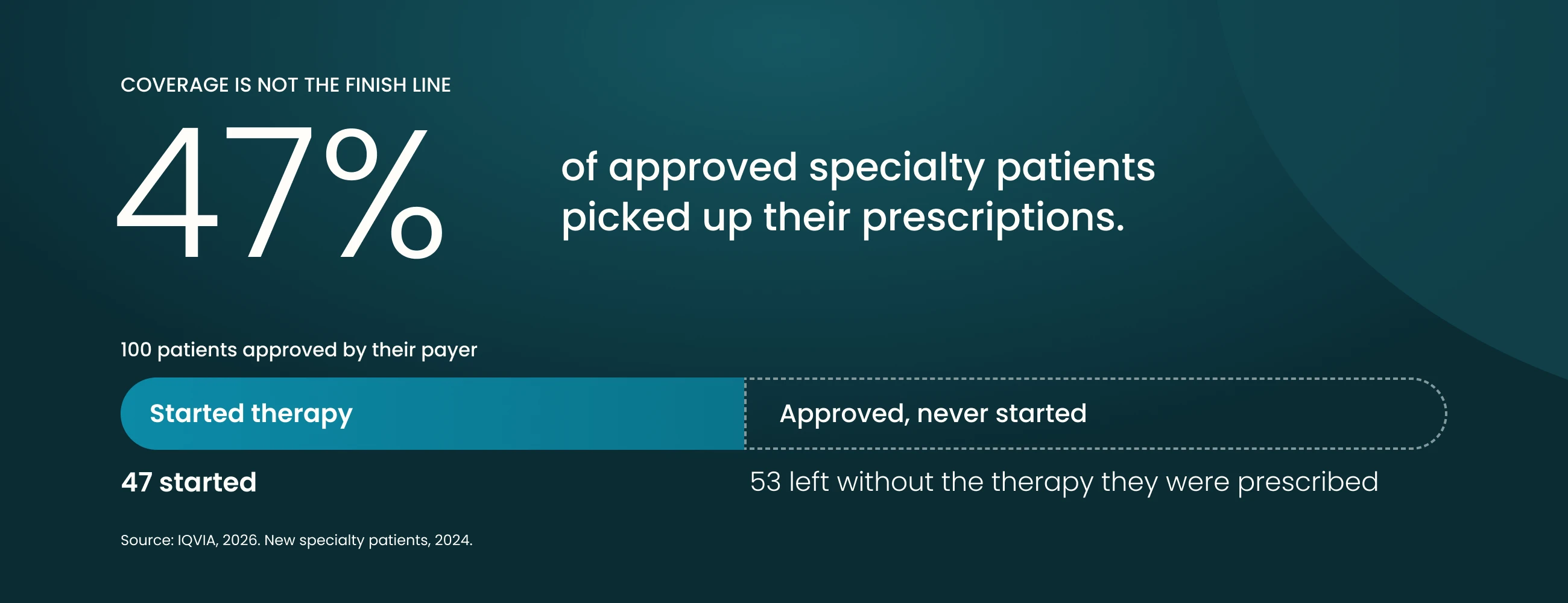
As previously stated, according to IQVIA's 2026 analysis, among patients seeking new specialty therapies in 2024, 40% of demand was lost to durable payer rejections. Of the patients who were approved, only 47% picked up their prescriptions.[2]
Coverage is not the finish line. Patients with an approved prescription still face barriers that keep them from starting therapy.
That is why prescription volume and approval counts tell only part of the story. The number that matters is how many patients actually move from prescription to treatment.
Why specialty prescriptions go unfilled
There is no single cause why these prescriptions often go unfilled. Patients run into a mix of financial, administrative, and operational barriers, and each one makes the next harder to clear.
1. Insurance approval is only the first hurdle
Prior authorizations, formulary restrictions, and coverage exclusions can delay treatment or block it entirely.
In 2026, IQVIA reported that only 30% of commercial new-to-brand prescriptions across retail and specialty products were approved within seven days in 2025, down from more than 50% in 2018.[2]
For patients, a slow approval means weeks of uncertainty. For care teams, it means repeated follow-up, documentation, and coordination across organizations. Approval does not end the process either. Patients can still face high out-of-pocket costs and more paperwork before therapy begins.
2. Affordability stops treatment before it starts
Specialty medications carry substantial costs, so affordability often decides whether a patient starts treatment at all.
The 2026 ICER analysis identified out-of-pocket costs, unmet deductibles, and limited cost transparency as potential contributors to prescription abandonment. It also highlighted how hard it can be for patients to access manufacturer assistance and other support programs.[1]
Finding a program is only the first step. Patients may need to meet eligibility requirements, complete applications, submit documentation, and wait for enrollment confirmation. When that process breaks down, the patient is left responsible for a medication they cannot afford.
3. Fragmented workflows let patients fall through the cracks
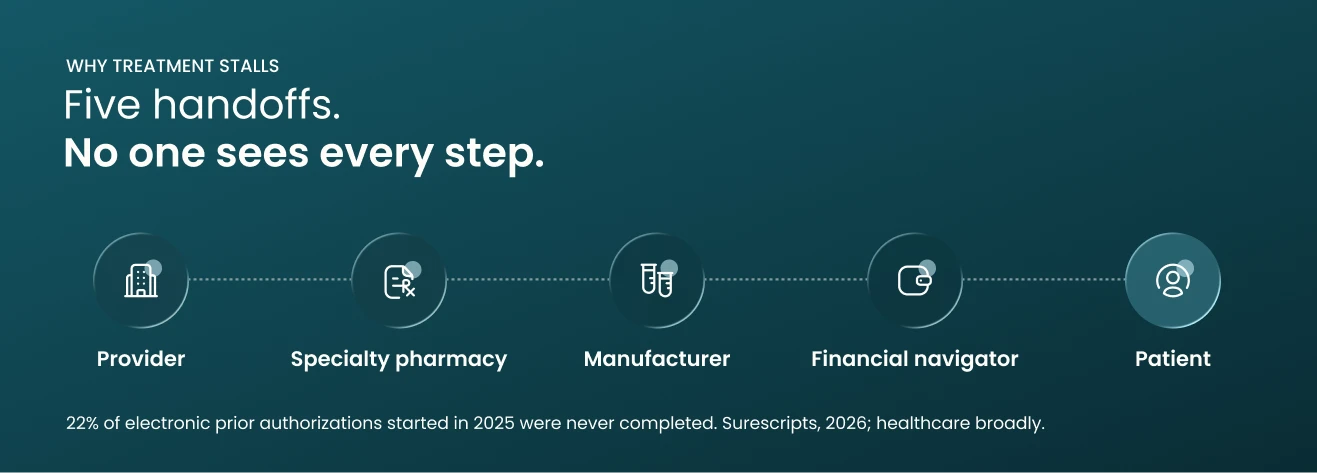
Specialty access usually involves several organizations working toward the same outcome. A provider submits the prescription. A specialty pharmacy handles fulfillment. A manufacturer may run a support program. A financial navigator searches for assistance. The patient waits for an update.
When those workflows are not connected and no one can see every step, delays pile up.
A 2026 Surescripts analysis found that 22% of electronic prior authorizations initiated in 2025 were not completed. The same organization reported that 27% of new prescriptions in its January 2026 analysis were never dispensed.[3]
These figures cover healthcare broadly, not specialty medications alone. They still show how administrative and operational barriers block fulfillment. For specialty therapies, where starting treatment takes several coordinated steps, connected communication and less manual work matter even more.
4. Patients are left to navigate it alone
Patients managing serious or chronic illness are already stretched on time, money, and emotional energy. Asking them to work through insurance requirements, assistance applications, pharmacy communications, and treatment logistics on their own adds one more burden.
Many patients do not know help exists. Others find a program but struggle to complete enrollment or understand what to do next.
When support depends on the patient spotting the problem and asking for help, the chance to step in early is lost.
Moving From Prescription Volume to Treatment Initiation
Closing the gap means treating prescribing, coverage, affordability, and fulfillment as one journey, not four separate handoffs. In practice, that means:
- Identifying barriers before they delay treatment
- Connecting patients with financial assistance earlier
- Automating repetitive administrative work
- Giving care teams visibility into every unresolved access issue
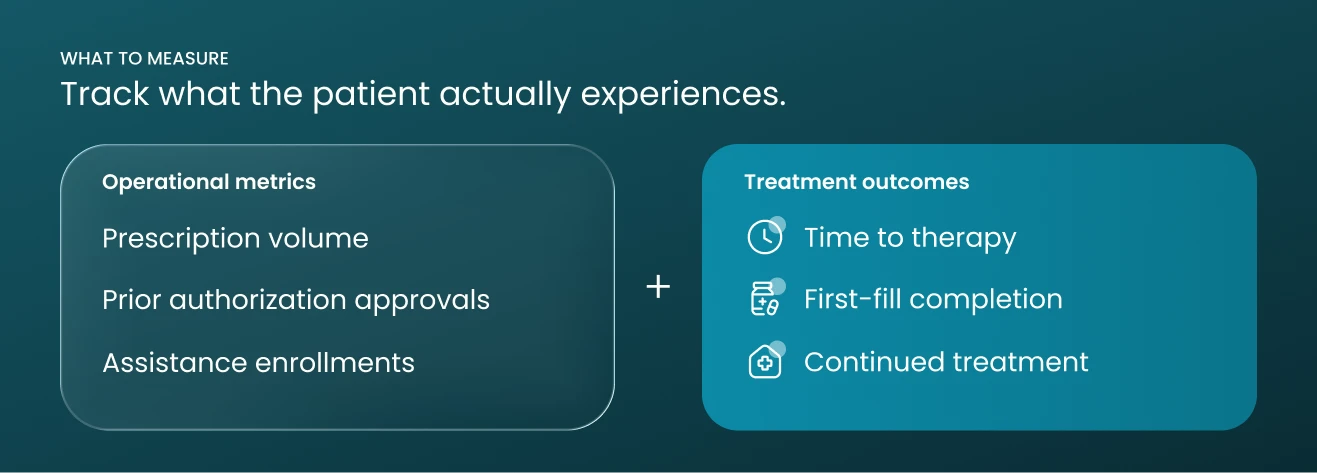
It also means measuring whether patients actually get their medications. Prescription volume, prior authorization approvals, and assistance enrollments are still useful operational metrics. They belong alongside time to therapy, first-fill completion, and continued treatment.
For specialty pharmacies and life sciences companies managing increasingly complex access requirements, those are the measures that reflect what the patient actually experiences.
Building a connected path to therapy
TailorMed is the medication success platform, built to ensure that every patient who is prescribed a medication can get it, afford it, and stay on it.
The traditional model puts the burden on the patient: find the program, call the manufacturer, figure out the paperwork. Point solutions make it worse. When affordability, adherence, and manufacturer programs sit with separate vendors, nothing is connected and patients slip through the gaps.
TailorMed was built to close those gaps across the full medication journey. Its network-powered platform connects patients, providers, pharmacies, and life sciences companies, so the right support reaches the right patient before a barrier becomes the reason they never start therapy.
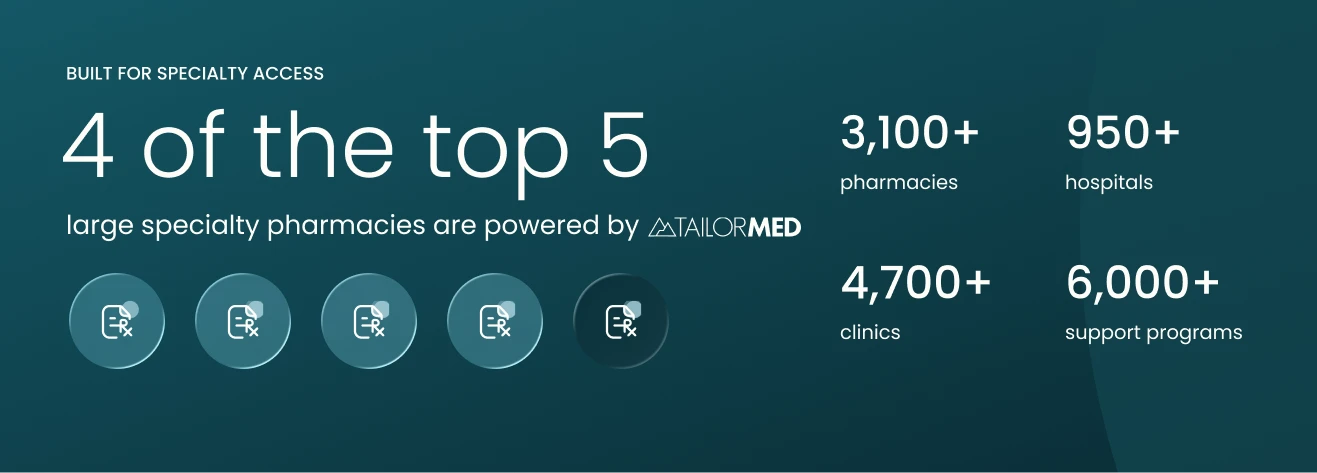
The network is what makes that possible. TailorMed connects 3,100+ pharmacies, 950+ hospitals, and 4,700+ clinics to 6,000+ available support programs, and powers 4 of the top 5 large specialty pharmacies.
Across the platform:
- TailorMed Core gives care teams one system to identify patients at financial risk, automate enrollment, and track every open access issue.
- TailorMed Complete extends care team capacity with TailorMed's in-house, expert navigators, without adding headcount.
- TailorMed Connect reaches patients directly through a self-serve experience, so they can find and enroll in support on their own schedule.
- TailorMed Amplify brings manufacturer programs to the patients who qualify for them, shortening time to therapy through 100+ direct Express Enroll integrations with manufacturers.
- Express Enroll auto-populates enrollment applications inside the workflow, cutting the repetitive data entry behind every submission.
For care teams, that means less time chasing disconnected processes and more time with patients. For patients, it means a clear path to the support and medications they need.
A prescription only succeeds when It reaches the patient
The gap between prescribing and treatment is still wide, even as specialty therapies keep advancing.
More coverage and more assistance programs will not close it on their own. It takes connecting the people, technology, and resources responsible for getting patients onto therapy.
Every unfilled prescription is a patient who may never benefit from the treatment their provider chose. The goal is to help more patients start the medications they need, and stay on them.
Every barrier removed. Every patient reached.
Ready to close the gap between prescription and treatment? Connect with TailorMed at tailormed.com to see how the medication success platform can help your organization improve access, simplify financial assistance, and support patients across the full medication journey.
Works Cited
- Institute for Clinical and Economic Review. “ICER's Launch Price and Access Report: 5 Key Takeaways and 5 Questions We Should All Be Asking.” 2026. https://pmc.ncbi.nlm.nih.gov/articles/PMC13032863/
- IQVIA. “Beyond Payer Rejections: Creating and Sustaining Demand.” August 2026. https://www.iqvia.com/locations/united-states/blogs/2026/08/beyond-payer-rejections-creating-and-sustaining-demand
- Surescripts. “How Real-Time Data Improves Specialty Drug Access.” 2026. https://surescripts.com/insights/specialty-prescriptions-patient-access-qa
About TailorMed
TailorMed is the medication success platform removing every barrier across the patient medication journey, from access and affordability through adherence and ongoing care. Through a connected network spanning 950+ hospitals, 4,700+ clinics, 3,100+ pharmacies, 100+ life sciences programs, and 6,000+ support programs, TailorMed has reached over 75 million patients and secured more than $7.4 billion in financial assistance since 2020. TailorMed's platform, including TailorMed Core, TailorMed Connect, TailorMed Complete, TailorMed Amplify, and TailorMed Alliance, connects patients, providers, pharmacies, and life sciences companies through one coordinated network designed to reach every patient at every step of their medication journey. Learn more at tailormed.com.
Media Contacts:
Jennifer Martin, VP, Marketing
jenm@tailormed.co
PR Contacts:
Glenn Goldberg
Parallel Communications Group
+1 516 776-3282
ggoldberg@parallelpr.com