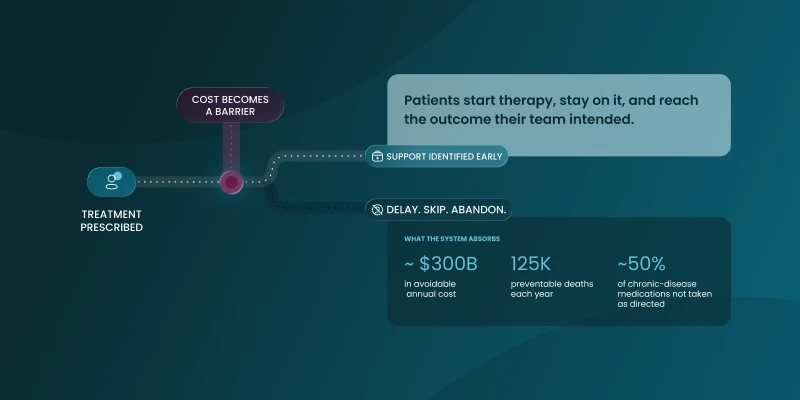
The $2,100 Cap Didn’t Fix Commercial Access
Medicare’s prescription drug cap protects Part D beneficiaries from runaway costs. Commercially insured patients have no equivalent protection, and coverage alone has never guaranteed access.
Having insurance does not mean a patient can afford their medication. One in five new prescriptions goes unfilled, and cost is the primary driver.
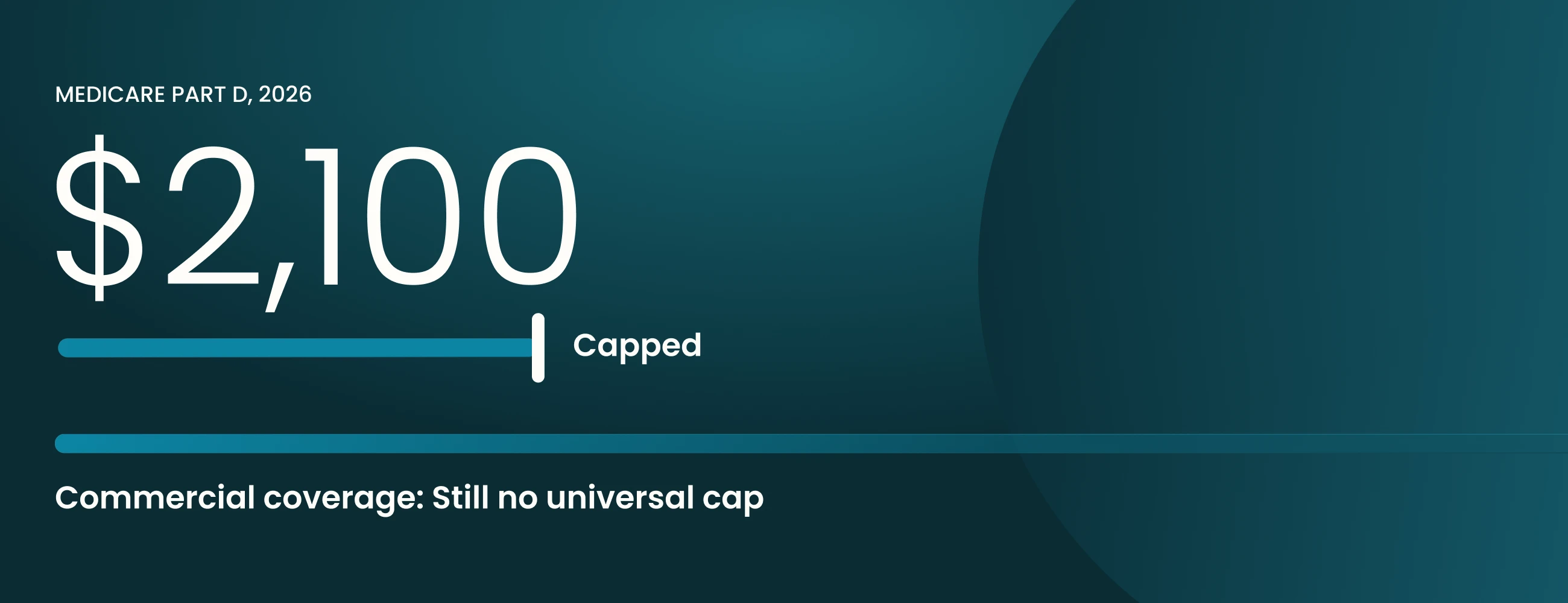
That is why Medicare’s annual out-of-pocket cap on prescription drugs was welcome news. Established under the Inflation Reduction Act, the cap began at $2,000 in 2025 and rose to $2,100 in 2026. It gives Medicare Part D beneficiaries real protection against unpredictable drug costs (CMS, 2025).
But the cap does not apply to the millions of Americans with commercial insurance. And even for patients it does protect, cost is only one of the barriers between a prescription and a patient who starts and stays on therapy.
A Medicare milestone with limits
The $2,100 cap is meaningful progress for Medicare beneficiaries managing chronic conditions and high-cost medications. Once eligible out-of-pocket spending reaches that threshold, patients pay nothing more for covered Part D drugs for the rest of the calendar year (CMS, 2025). Beneficiaries can also opt into the Medicare Prescription Payment Plan, which spreads out-of-pocket drug costs into monthly payments across the year instead of requiring payment at the pharmacy counter (Medicare.gov, 2026).
The numbers are still moving. In 2027, the Part D cap will rise to $2,400, and the standard deductible will increase from $615 to $700. Changes to a temporary premium subsidy program could also affect what some beneficiaries pay for coverage (Associated Press, 2026). Patients who budgeted around this year’s figures will face a different picture next year.
Commercially insured patients face a different problem entirely.
According to KFF’s 2025 Employer Health Benefits Survey, 92% of covered workers are enrolled in plans with tiered prescription drug cost sharing. Among workers in plans with three or more tiers, average copayments range from $12 for first-tier medications to $123 for fourth-tier medications. Specialty medications may carry additional cost sharing (KFF, 2025).
For patients on high-cost therapies for cancer, autoimmune disease, or other complex conditions, those costs add up fast.
Commercial coverage has no universal equivalent to the $2,100 Part D cap. Many commercial plans do set annual out-of-pocket maximums for covered in-network care, but the amounts and benefit designs vary widely.
The result: patients who have coverage and still cannot get the medication they were prescribed.
The barriers go beyond the copay
For a commercially insured patient, getting on therapy can involve far more than paying a copay.
Depending on the treatment and the plan, a patient may need to find manufacturer copay assistance, complete enrollment requirements, deal with accumulator or maximizer policies, or wait on prior authorization before treatment can begin.
Support programs exist, but availability and eligibility vary. Manufacturer copay programs generally serve eligible commercially insured patients. Independent charitable foundations may support qualifying patients across different insurance types.
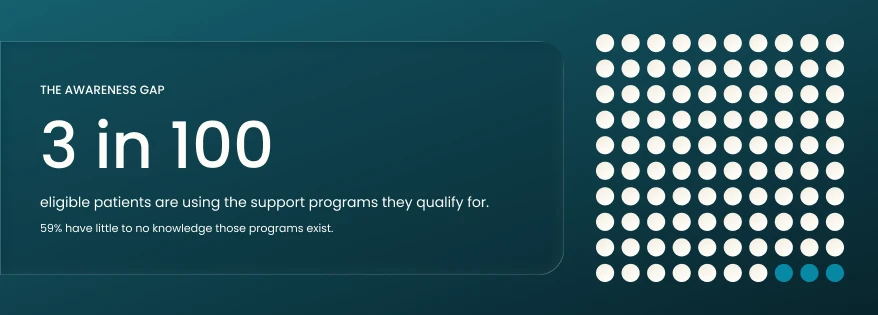
Most patients never find them. Only 3% of eligible patients are using the support programs they qualify for, and 59% have little to no knowledge that those programs exist.
For providers and pharmacies, finding the right program usually means working across multiple systems, tracking shifting eligibility criteria, and absorbing hours of manual work per patient.
The consequences are concrete. A patient who cannot afford the first fill delays starting therapy. A patient hit with an unexpected cost increase stops refilling. A care team with no visibility into available programs misses the chance to remove a barrier before it interrupts care.
The problem is rarely a lack of assistance. It is connecting the right patient to the right program at the right time.
Removing barriers has to be part of the medication journey
Policy can reduce financial exposure for some patients. It cannot fix the operational gaps that keep patients from starting and staying on treatment.
That work falls to the organizations already on the medication journey with the patient: providers, specialty pharmacies, and life sciences companies. The goal is to identify and resolve barriers before cost becomes the reason a patient abandons or delays treatment.

In practice, that means care teams can:
- Identify barriers earlier. Flag patients at financial risk and surface matching programs before treatment is delayed.
- Simplify enrollment. Cut the manual work of finding programs, checking eligibility, and submitting applications.
- See where every patient stands. Know which patients are enrolled, which are pending, and which need more support.
- Keep patients on therapy. Catch expiring assistance, eligibility changes, and newly available funding before they cause a gap in care.
This matters across every coverage type. Medicare patients may still need help with costs outside the Part D cap. Commercially insured patients may need help managing substantial cost sharing.
Either way, it works best when it is built into care delivery, not handled as a separate administrative task.
Closing the gap between coverage and access
TailorMed is the medication success platform, built to ensure that every patient who is prescribed a medication can get it, afford it, and stay on it.
Our network-powered platform connects providers, pharmacies, life sciences companies, and patients across 950+ hospitals, 4,700+ clinics, and 3,100+ pharmacies, with access to 6,000+ available programs. Since 2020, it has secured more than $7.4 billion in financial assistance for patients.
TailorMed automates program discovery, eligibility screening, enrollment, and ongoing support, so care teams can connect patients to the resources they qualify for without the manual burden. As policy changes, benefit designs shift, and programs evolve, that connected approach is what keeps patients from falling through the gaps.
The Part D cap shows what is possible when affordability becomes a priority. It also shows how much work remains for patients outside its protections.
Progress is not measured by whether a patient has insurance or whether a new spending limit exists. It is measured by whether that patient can start and stay on the treatment they need.
Every barrier removed. Every patient reached.
See how TailorMed removes barriers across the medication journey.
Works Cited
- Associated Press. “A New Medicare Season Begins, but Some Shifts Will Arrive in 2027.” AP News, 15 Oct. 2026. https://apnews.com/article/4292bebf65caeebd6d60c0160d7b6216.
- Centers for Medicare & Medicaid Services. “Final CY 2026 Part D Redesign Program Instructions.” CMS, 7 Apr. 2025. https://www.cms.gov/newsroom/fact-sheets/final-cy-2026-part-d-redesign-program-instructions.
- KFF. “2025 Employer Health Benefits Survey.” KFF, 2025. https://www.kff.org/health-costs/2025-employer-health-benefits-survey/.
- Medicare.gov. “Before Using This Payment Option.” Medicare, 2026. https://www.medicare.gov/prescription-payment-plan/before-payment-option.
About TailorMed
TailorMed is the medication success platform removing every barrier across the patient medication journey, from access and affordability through adherence and ongoing care. Through a connected network spanning 945+ hospitals, 4,700+ clinics, 3,100+ pharmacies, 100+ life sciences programs, and 6,000+ support programs, TailorMed has supported over 75 million patients and secured more than $7.4 billion in financial assistance since 2020. TailorMed's platform, including TailorMed Core, TailorMed Connect, TailorMed Complete, TailorMed Amplify, and TailorMed Alliance, connects patients, providers, pharmacies, and life sciences companies through one coordinated network designed to reach every patient at every step of their medication journey. Learn more at tailormed.com.
Media Contacts:
Jennifer Martin, VP, Marketing
jenm@tailormed.co
PR Contacts:
Glenn Goldberg
Parallel Communications Group
+1 516 776-3282
𝕏: @Parallel_PR
LinkedIn
ggoldberg@parallelpr.com