From Spreadsheets to Systems: The History Behind the Medication Success Platform
.webp)
For most of modern American healthcare, financial navigation was not a job title, a technology category, or even a formal concept. It was a favor. A billing clerk kept a manila folder of drug company phone numbers. A nurse remembered which patients qualified for a hardship fund. A social worker searched foundation grants between appointments. The industry never lacked the will to help patients afford care. It lacked the infrastructure.
TailorMed exists because that infrastructure gap grew, decade after decade, into a crisis too large for goodwill and spreadsheets to solve. Understanding how the industry got here means tracing four converging storylines: the rise of specialty drug costs, the growth of a patchwork patient-assistance system, the slow professionalization of financial navigation as a discipline, and the policy fights that make the journey harder to navigate every year.
The 1990s to 2000s: Specialty Drugs Outgrow the System Built to Pay for Them
Specialty pharmacy barely existed as a category in the mid-1990s. Fewer than 30 specialty drugs were on the market at that time, compared with more than 200 in the years that followed.[1] These were high-touch, high-cost biologics for conditions like HIV, multiple sclerosis, and rheumatoid arthritis, and they did not fit into the pharmacy benefit structures insurers had built for cheap, high-volume generics.
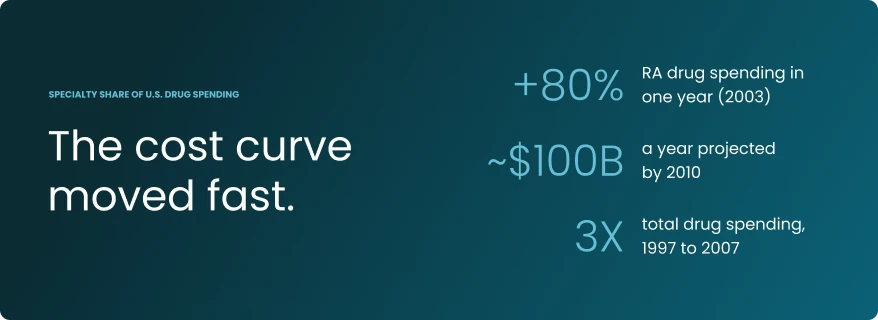
The cost curve moved fast. Drug spending in the U.S. began climbing sharply in 1997 and tripled over the following decade.[2] By the mid-2000s, specialty spending specifically was compounding at a startling rate. One industry analysis projected specialty spend would jump from 19% to 26% of total drug spending between 2006 and 2010, potentially approaching $100 billion a year.[1] Rheumatology and oncology led the surge: a 2003 industry report found rheumatoid arthritis drug spending alone rose more than 80% in a single year, with cancer and hemophilia therapies also driving overall trend growth.[3]
Health systems and pharmacies scrambled to build capacity around these drugs, but almost nothing was built to help the patient absorb the cost. Financial assistance, where it existed, ran through disconnected channels: manufacturer coupons, a handful of new nonprofit foundations, and whatever a hospital's charity-care policy happened to cover. The barriers were already stacking up across the medication journey, long before anyone had a name for them.
The 2000s: Charitable Foundations Fill the Gap, Not the System
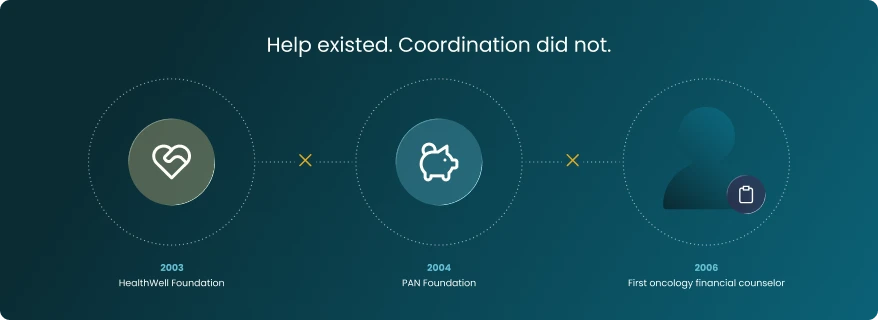
Two of the largest patient assistance foundations were founded within a year of each other: the HealthWell Foundation in 2003,[4] and the PAN Foundation in 2004.[5] These organizations, along with a handful of peers, took on a role the healthcare system itself had not built. Within just a few years of launching, the two largest copay foundations had each already helped tens of thousands of insured patients afford treatment.[6]
The same period saw the first dedicated financial roles inside provider organizations. Lori Schneider helped create one of the first financial counselor roles in oncology at Green Bay Oncology in Wisconsin in 2006,[7] years before "financial navigator" was a recognized job title anywhere else in the industry. It was, by her own account, a role invented to meet a need that had no existing infrastructure to support it.
The problem: none of this was coordinated. A financial counselor in one clinic had no way of knowing what a foundation in another state was funding that quarter, whether a manufacturer coupon had run out, or whether a patient's insurance change had just made them ineligible for the assistance they had relied on. Matching patients to resources was manual, reactive, and dependent entirely on one person's network of contacts. There was no system connecting patients, providers, and the programs meant to reach them.
2013: The Industry Finally Names the Problem
For years, clinicians had a word for what chemotherapy did to a patient's body: toxicity. In 2013, researchers gave a name to what treatment costs did to a patient's finances. A pilot study published in The Oncologist that year was the first in the published academic literature to use the term "financial toxicity," describing the out-of-pocket burden experienced even by insured cancer patients.[8] It was not the first paper to note that cost affected care, but that 2013 article catalyzed an entire field of research and quality-improvement work focused on patient affordability.[9] Within a decade, more than 700 PubMed-indexed articles had used the term.[8]
The timing mattered. Naming the problem gave hospital administrators, oncology societies, and eventually technology companies a shared vocabulary, and a business case, for building something more systematic than one counselor's personal network.
The 2010s: Patient Navigation Grows Up, but Stays Manual
Financial navigation did not emerge in a vacuum. It grew out of an older patient-navigation movement. The concept traces back to 1990, when Dr. Harold Freeman launched the nation's first patient navigation program at Harlem Hospital in response to findings on inequities in cancer diagnosis and treatment.[10] By the 2010s, cancer centers nationwide were formalizing navigator roles, and organizations like the Association of Cancer Care Centers (ACCC) built entire practice networks around financial advocacy.
But even as the role professionalized, the tools did not keep pace. Navigators were still working from spreadsheets, paper applications, and personal knowledge of which foundation funds happened to be open. Industry surveys from this era show programs measuring success by polling staff rather than pulling data from a system, because no unified system existed. As late as the mid-2020s, cancer programs were still describing the move to an automated financial navigation system, one that could track new and dynamic grant sources and generate predictive analytics, as a significant operational upgrade,[11] underscoring just how recently most of the industry was still working manually.
Meanwhile, the underlying cost pressure kept building. By the late 2010s, specialty medications accounted for nearly half of all U.S. drug expenditures,[1] even though specialty drugs represented a small share of total prescriptions.
The 2010s to 2020s: A New Threat, Assistance Programs Get Clawed Back
Just as manufacturer copay cards and charitable grants became a lifeline for patients, payers found a way to capture that value instead. Copay accumulator and maximizer programs emerged as a strategy for health plans to apply manufacturer assistance to a patient's bill without counting it toward the patient's deductible or out-of-pocket maximum. By 2023, these programs accounted for $4.8 billion in redirected value,[12] and copay assistance had grown to cover an estimated 19% of prescriptions among privately insured patients that year, worth roughly $23 billion in total.[13]
The practical effect was that patients could exhaust their assistance without it ever reducing what they truly owed, then face a sudden, unexpected bill once the coupon ran dry. By 2024, nearly one in five large employer health plans included a copay accumulator provision, rising to one-third among the largest employers.[13] Navigating financial assistance was no longer just about finding help. It required understanding an increasingly adversarial set of plan designs working against the assistance itself.
The human cost of all of this became impossible to ignore. By the early 2020s, people in the U.S. owed an estimated $220 billion in medical debt, with roughly 14 million people carrying more than $1,000 in medical debt each.[14] Research also found that a third of privately insured single-person households did not even have $2,000 in savings to absorb an unexpected medical bill,[15] meaning even patients with good insurance were one specialty prescription away from financial crisis.
2017: TailorMed Is Built to Close the Gap
This was the environment TailorMed was built into: rising specialty drug costs, a fragmented and underfunded charitable system, a navigator workforce still working from memory and spreadsheets, and payer tactics actively working against the assistance patients did manage to secure. TailorMed's founders experienced this firsthand as caregivers navigating the system from the inside after family members were diagnosed with serious illnesses, not because care did not exist, but because access, affordability, and support were hard to reach when they mattered most.[16]
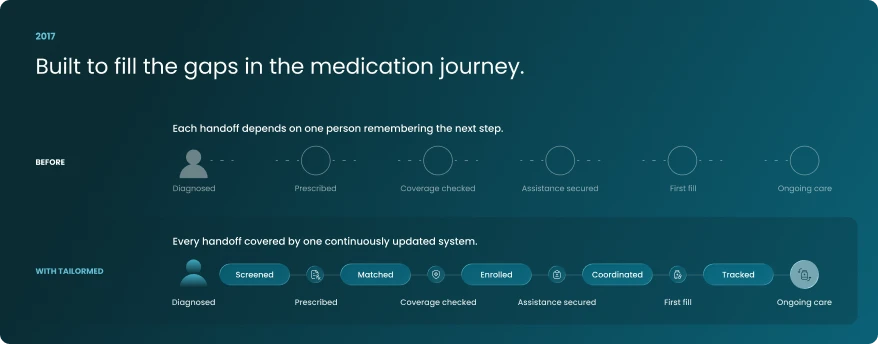
TailorMed is the Medication Success Platform, built to ensure that every patient who is prescribed a medication can get it, afford it, and stay on it. The answer was to do programmatically what navigators had been doing manually for two decades: build a network-powered platform that proactively identifies financial assistance opportunities at scale, across the nation's largest and most diverse network of healthcare organizations, life sciences companies, and assistance programs.[17] Instead of one counselor's list of contacts, TailorMed connects providers, pharmacies, patients, and life sciences companies through a single, continuously updated system. Instead of discovering a patient's eligibility gap after a denied claim, the platform is built to flag it before treatment starts, removing barriers across the full medication journey rather than at one moment in it.
Why This History Matters
The story of financial navigation is not a straight line of progress. It is a story of an industry that kept adding complexity, more expensive drugs, more assistance programs, more plan-design workarounds, faster than it added infrastructure to manage that complexity. Every actor along the way, foundations, financial counselors, policy advocates, ACCC's navigator network, solved a piece of the problem with the tools available at the time. What none of those pieces could do alone was connect all of it into a single, proactive system.
That is the gap TailorMed was built to close. It took thirty years of rising costs, patchwork charity, professional advocacy, and hard-won data on medical debt to make the case that financial navigation needed to become infrastructure, not an act of individual heroism.
TailorMed is the Medication Success Platform, built to ensure that every patient who is prescribed a medication can get it, afford it, and stay on it. Through a connected network spanning 945+ hospitals, 4,700+ clinics, 3,100+ pharmacies, 100+ life sciences programs, and 6,000+ support programs, TailorMed reaches 75 million patients and has secured more than $7.4 billion in financial assistance since 2020. TailorMed connects providers, pharmacies, patients, and life sciences companies through one coordinated infrastructure designed to reach every patient at every step of their medication journey. Learn more at tailormed.com.
Works Cited
- IntuitionLabs. "What Is Specialty Pharmacy? A Guide to High-Cost Drugs." IntuitionLabs, intuitionlabs.ai/articles/what-is-specialty-pharmacy.
- "Drug Price Increases: Here We Go Again?" Pharmacy Times, pharmacytimes.com/view/drug-price-increases-here-we-go-again.
- "Medco Health Solutions Release: Specialty Drug Spending Climbs 26 Percent in 2003, Driven by Arthritis, Cancer Therapies." BioSpace, biospace.com/b-medco-health-solutions-inc-b-release-specialty-drug-spending-climbs-26-percent-in-2003-driven-by-arthritis-cancer-therapies.
- "HealthWell Foundation." GuideStar Nonprofit Profile, Candid, guidestar.org/profile/20-0413676.
- "About PAN." PAN Foundation, panfoundation.org.
- "Copayment Foundations: Help for the Underinsured." PMC, National Institutes of Health, pmc.ncbi.nlm.nih.gov/articles/PMC2702190/.
- "The Evolving Role of the Financial Navigator." ACCCBuzz, Association of Cancer Care Centers, 6 Feb. 2020, accc-cancer.org/acccbuzz/blog-post-template/accc-buzz/2020/02/06/the-evolving-role-of-the-financial-navigator.
- "Reflections on the Financial Toxicity of Cancer: 10 Years Later." The Oncologist, Oxford Academic, academic.oup.com/oncolo/article/28/8/654/7197996.
- "Financial Toxicity in Cancer Care: Where Are We, and How Did We Get Here? Introduction to a Special Series." JCO Oncology Practice, ascopubs.org/doi/10.1200/OP-24-00793.
- "Honoring Oncology Nurse Navigators." ACCCBuzz, Association of Cancer Care Centers, accc-cancer.org/view/honoring-oncology-nurse-navigators.
- "ACCC Pre-Conference Affirms Growing Role of the Financial Navigator." ACCCBuzz, Association of Cancer Care Centers, accc-cancer.org/view/accc-pre-conference-affirms-growing-role-of-the-financial-navigator.
- "Copay Accumulator and Maximizer Programs: Stakes Rise for Patients as Federal Rulemaking Lags." Health Affairs Forefront, healthaffairs.org/content/forefront/copay-accumulator-and-maximizer-programs-stakes-rise-patients-federal-rulemaking-lags.
- "Copay Adjustment Programs: What Are They and What Do They Mean for Consumers?" KFF, kff.org/health-costs/copay-adjustment-programs-what-are-they-and-what-do-they-mean-for-consumers/.
- "The Burden of Medical Debt in the United States." KFF, kff.org/health-costs/the-burden-of-medical-debt-in-the-united-states/.
- "The Burden of Medical Debt in the United States." Peterson-KFF Health System Tracker, healthsystemtracker.org/brief/the-burden-of-medical-debt-in-the-united-states/.
- TailorMed. "Company: Removing Barriers Along the Medication Journey." TailorMed, tailormed.com/company.
- TailorMed. "Learn About TailorMed's Mission." TailorMed, tailormed.com/company/.
About TailorMed
TailorMed is the medication success platform removing every barrier across the patient medication journey, from access and affordability through adherence and ongoing care. Through a connected network spanning 945+ hospitals, 4,700+ clinics, 3,100+ pharmacies, 100+ life sciences programs, and 6,000+ support programs, TailorMed has supported over 75 million patients and secured more than $7.4 billion in financial assistance since 2020. TailorMed's platform, including TailorMed Core, TailorMed Connect, TailorMed Complete, TailorMed Amplify, and TailorMed Alliance, connects patients, providers, pharmacies, and life sciences companies through one coordinated network designed to reach every patient at every step of their medication journey. Learn more at tailormed.com.
Media Contacts:
Jennifer Martin, VP, Marketing
jenm@tailormed.co
PR Contacts:
Glenn Goldberg
Parallel Communications Group
+1 516 776-3282
𝕏: @Parallel_PR
LinkedIn
ggoldberg@parallelpr.com
.webp)